- Keyed (our default specification)
- Digital
Storage Cabinets & Cupboards
The general-purpose steel cupboard, done properly
Two-door cupboards, filing and archive cabinets, glass-fronted display units and low credenzas — the everyday storage that fills back offices, committee rooms, stores and clinic corridors. Keyed as standard and unglamorous, but the part of a fit-out that gets used every day and is noticed when it is flimsy.
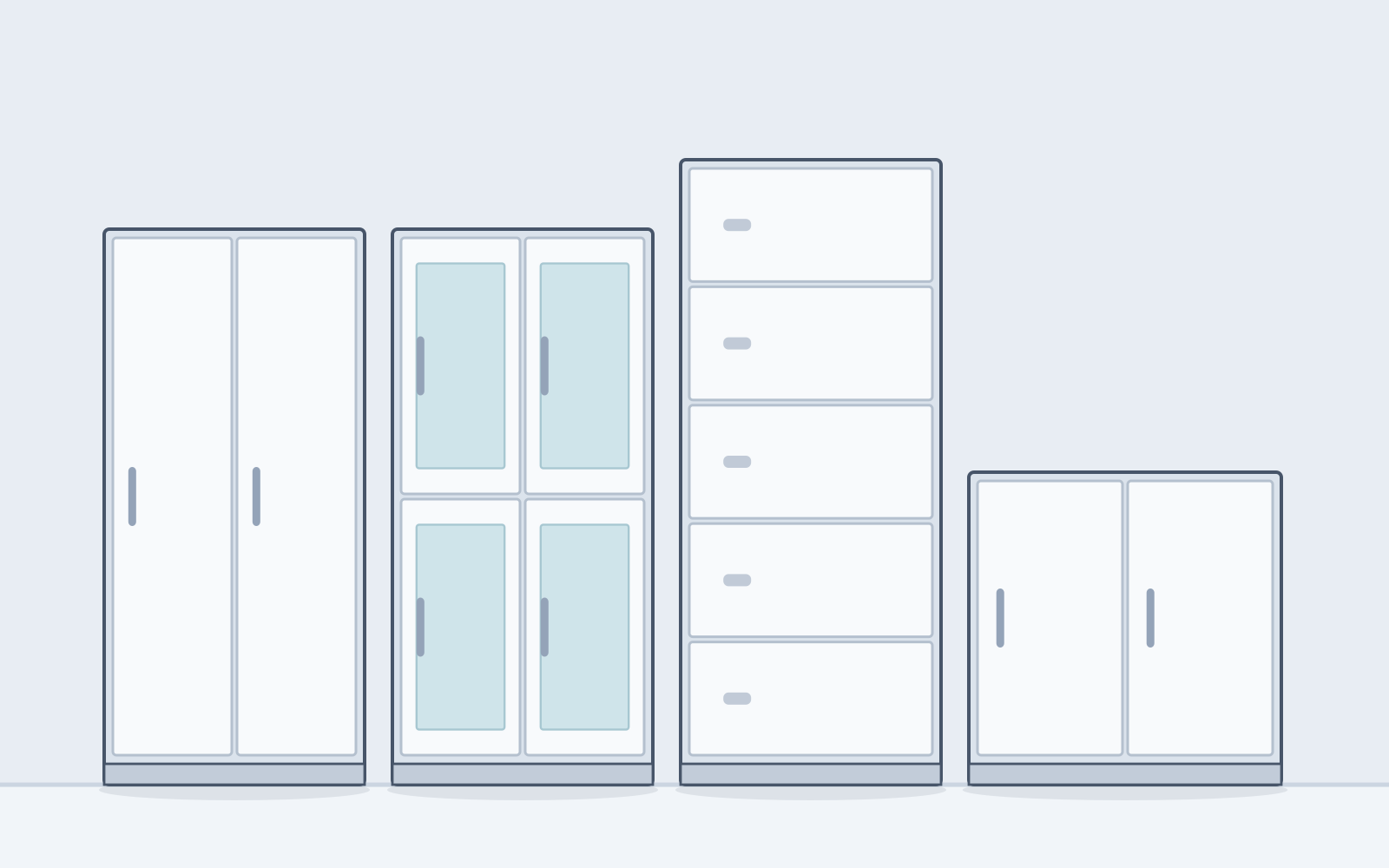
Quick answer: storage cabinets & cupboards in Singapore
Two-door cupboards, filing and archive cabinets, glass-fronted display units and low credenzas — the everyday storage that fills back offices, committee rooms, stores and clinic corridors. Keyed as standard and unglamorous, but the part of a fit-out that gets used every day and is noticed when it is flimsy.
Keyed is the right answer here and we will say so before you ask. A three-point lock with two keys on a cupboard used by a handful of staff is not a compromise, it is the correct specification. A battery keypad lock is worth it only where the key has already become a nuisance — a shared cleaning store, a cupboard nobody can find the key for. Standard finishes are grey-white, coffee-white and ivory. Handle colours are specified separately — white, silver, dark grey, brown, orange, red, blue and green are all stock pigments, and a coloured handle is the cheapest way to make a functional cabinet look deliberate.
Lock options
The lock is specified per bank, separately from the cabinet. We would specify keyed & mechanical locks on this family unless you tell us otherwise.
| Tier | What it means here | Needs | Cost |
|---|---|---|---|
| Keyed Our default here | Cam lock, padlock hasp or combination dial. No power, no batteries, no fee. | Nothing. No socket, no battery, no connection. | Lowest per compartment |
| Digital | Battery keypad, card or fingerprint lock per door. Offline, no wiring, no subscription. | Batteries in each lock, typically replaced yearly. No socket, no cabling, no network, no IT involvement. | Mid — hardware only, no recurring fee |
What we would recommend, and why
Keyed is the right answer here and we will say so before you ask. A three-point lock with two keys on a cupboard used by a handful of staff is not a compromise, it is the correct specification. A battery keypad lock is worth it only where the key has already become a nuisance — a shared cleaning store, a cupboard nobody can find the key for.
Compare all three tiers →Standard configurations
These cover the large majority of enquiries and are the fastest and cheapest route to a delivered installation. Anything here can also be made to a different size.
| Configuration | W × D × H (mm) | Notes |
|---|---|---|
| Two-door cupboard | 900 × 400 × 1850 | Four adjustable shelves — the default general store cupboard |
| Glass-fronted upper, solid lower | 900 × 390–400 × 1850 | For anything that should be visible and still locked away |
| Two-drawer and shelf combination | 900 × 390–400 × 1850 | |
| Five-tier archive cabinet | 900 × 400 × 2050 | Maximum filing capacity per metre of wall |
| Low two-door credenza | 900 × 400 × 1090 | Sits under a window or serves as a counter |
| Sliding-door cabinet | 850–1180 × 390–400 × 1800 | |
| Multi-drawer card cabinet | 950 × 350 × 1600 | 24 shallow drawers, for small parts and records |
Dimensions are stated as width × depth × height in millimetres throughout this site. Factory drawings often mix conventions, so confirm against the dimensioned drawing issued with your quotation before any builder’s work is committed.
Made to order
Standard finishes are grey-white, coffee-white and ivory. Handle colours are specified separately — white, silver, dark grey, brown, orange, red, blue and green are all stock pigments, and a coloured handle is the cheapest way to make a functional cabinet look deliberate.
Construction & specification
- Cold-rolled steel, 0.5–1.2 mm depending on panel and family, with welded or knock-down assembly
- Electrostatic powder coat, phosphate-free — standard greys and off-whites, plus colour and wood-effect finishes to order
- Adjustable shelves on a punched pitch, rated for filing rather than paperwork only
- Three-point locking on full-height doors so a loaded cabinet cannot be sprung open at a corner
- Concealed hinges and soft-close options on front-of-house units
- Toughened glass in glazed doors, framed rather than bonded
- Levelling feet and anti-tip fixings for wall anchoring
What goes in them
- Files, records and archive boxes
- Club and estate documents
- Stationery, print and consumables
- Cleaning and housekeeping supplies
- First aid and clinic stock
- AV kit, cables and spares
Who specifies these
The cabinet barely changes between these. What changes is the compartment mix, the access rules and who administers it — so it is worth reading the page written for your situation.
Storage cabinets — questions we get asked
What is the difference between a filing cabinet and an archive cabinet?
Capacity and how often you open it. A filing cabinet at 1850 mm gives four working shelves at a comfortable reach. A five-tier archive cabinet at 2050 mm adds a fifth shelf above head height, which holds considerably more per metre of floor but is awkward for anything consulted daily. Use archive units for material you keep and rarely touch, and filing units for live records.
Can storage cabinets be given keyless access too?
They can, and for most cupboards they should not be. A single-door store cupboard used by three staff is well served by a good keyed lock, and that is what we will quote. A battery keypad lock is the sensible middle step where handing out keys has already become a nuisance — a shared cleaning store, a stationery cupboard nobody can find the key for. Full connected access on a cupboard is rarely worth its subscription, and the exceptions are specific: a controlled drug cupboard, a records cabinet under a retention policy, anywhere you need to prove who opened it. For those, see the secure cabinets family. We will tell you which of your cabinets genuinely warrant it, and it is usually fewer than people expect.
How long do steel cabinets take to arrive?
Standard sizes in standard finishes typically run six to eight weeks including sea freight and delivery in Singapore. A custom colour adds a powder-coat run; custom sizes add fabrication time. We hold no large local stock, and any supplier quoting a two-week lead time on a full fit-out is either selling from someone else's stock or air-freighting at a cost that will appear somewhere in your price.