- Keyed
- Digital (our default specification)
- Connected
Device & Charging Lockers
Phones and devices stored, charged and accounted for
High-density compartment cabinets with a mains socket inside every cell, so a device charges while it is locked away. Used where phones must be surrendered — examination halls, secure meeting rooms, clean rooms, production floors — and for pooled tablets, radios and scanners that have to come back charged.
Quick answer: device & charging lockers in Singapore
High-density compartment cabinets with a mains socket inside every cell, so a device charges while it is locked away. Used where phones must be surrendered — examination halls, secure meeting rooms, clean rooms, production floors — and for pooled tablets, radios and scanners that have to come back charged.
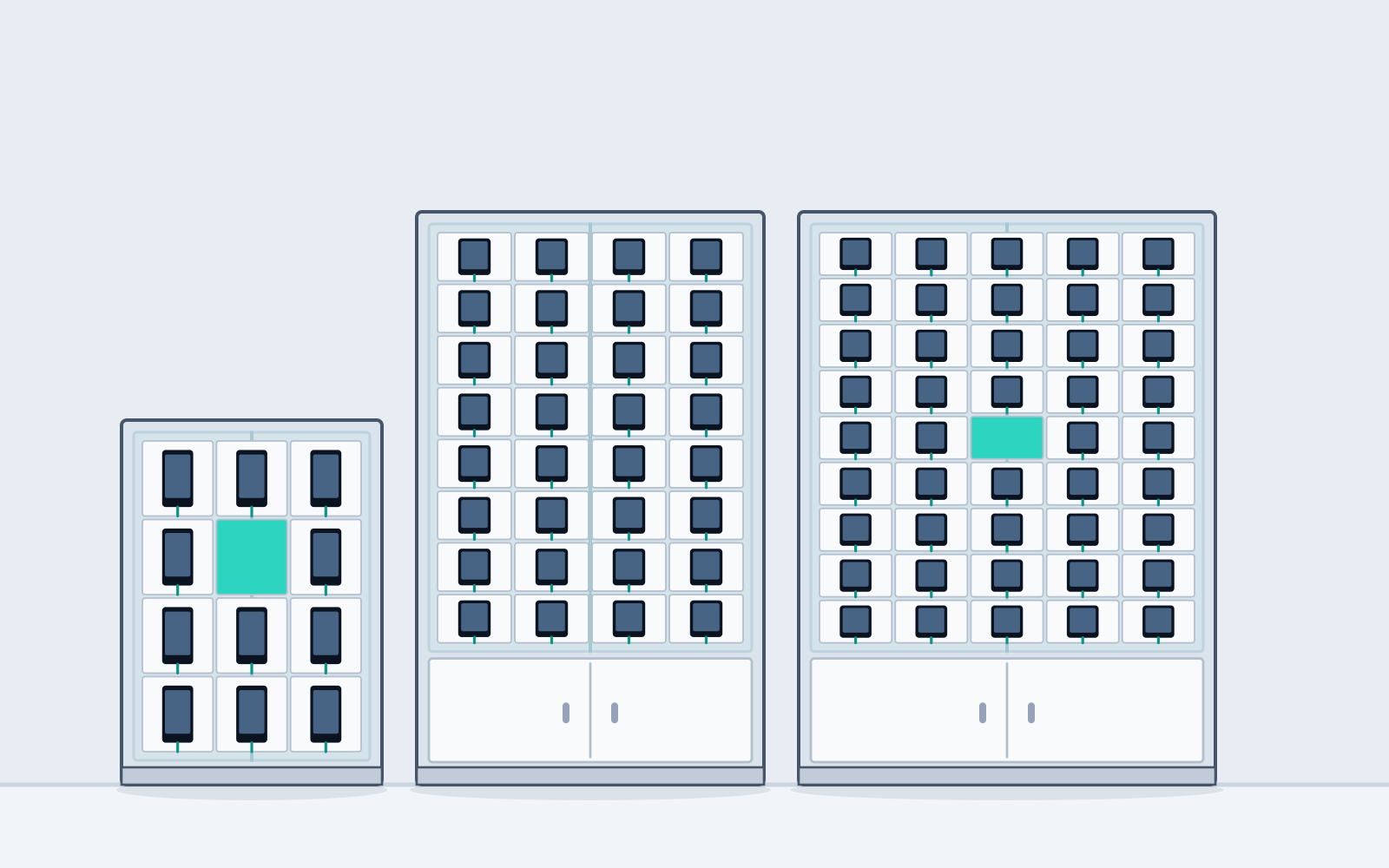
The cell lock is specified independently of the charging. Keyed cells are cheapest and are fine for an examination hall run by an invigilator with a key ring. Keypad cells suit a reception where users lock their own phone away. Connected cells are for pooled devices that must be signed out, accounted for, and held back until actually charged. 72 and 84-compartment layouts and non-charging variants are standard, and cell size can be enlarged for tablets, radios, barcode scanners or power tool batteries. Specify whether you need a socket in every cell or only in some — it changes the price meaningfully.
Lock options
The lock is specified per bank, separately from the cabinet. We would specify digital keypad & card locks on this family unless you tell us otherwise.
| Tier | What it means here | Needs | Cost |
|---|---|---|---|
| Keyed | Cam lock, padlock hasp or combination dial. No power, no batteries, no fee. | Nothing. No socket, no battery, no connection. | Lowest per compartment |
| Digital Our default here | Battery keypad, card or fingerprint lock per door. Offline, no wiring, no subscription. | Batteries in each lock, typically replaced yearly. No socket, no cabling, no network, no IT involvement. | Mid — hardware only, no recurring fee |
| Connected | Electronic latch on the Latchwork platform — QR, PIN, card and remote release, with a full log. | One standard 3-pin 230 V socket per bank. The controller reaches us over 4G, so no structured cabling, no switch ports, no firewall rules and nothing for site IT to approve. Wi-Fi is supported where preferred. | Highest — hardware per compartment plus an annual subscription per bank |
What we would recommend, and why
The cell lock is specified independently of the charging. Keyed cells are cheapest and are fine for an examination hall run by an invigilator with a key ring. Keypad cells suit a reception where users lock their own phone away. Connected cells are for pooled devices that must be signed out, accounted for, and held back until actually charged.
Compare all three tiers →Standard configurations
These cover the large majority of enquiries and are the fastest and cheapest route to a delivered installation. Anything here can also be made to a different size.
| Configuration | Compartments | W × D × H (mm) | Notes |
|---|---|---|---|
| 12-compartment | 150 × 150 mm cells | 610 × 350 × 810 | Desktop or wall-mounted |
| 24-compartment | 150 × 150 mm cells | 780 × 350 × 1150 | |
| 30-compartment | 150 × 150 mm cells | 950 × 350 × 1150 | |
| 40-compartment | 150 × 150 mm cells | 950 × 350 × 1850 | With a full-width lower cabinet for chargers and cables |
| 50-compartment | 150 × 150 mm cells | 950 × 350 × 1850 | |
| 60-compartment | 150 × 150 mm cells | 1120 × 350 × 1850 | |
| 84-compartment | 154 × 126 mm cells | 1300 × 350 × 1850 | Highest density — phones only, no cases |
Dimensions are stated as width × depth × height in millimetres throughout this site. Factory drawings often mix conventions, so confirm against the dimensioned drawing issued with your quotation before any builder’s work is committed.
Made to order
72 and 84-compartment layouts and non-charging variants are standard, and cell size can be enlarged for tablets, radios, barcode scanners or power tool batteries. Specify whether you need a socket in every cell or only in some — it changes the price meaningfully.
Construction & specification
- Cold-rolled steel body with toughened glass or solid steel doors, specified per cell row
- Five-hole 230 V socket per compartment as standard; USB-A and USB-C outlets on request
- Residual current protection on the supply, with per-row circuit separation
- Individually locked cells — keyed, battery keypad, card, or connected to the Latchwork platform
- Numbered door plates and an acrylic keypad panel
- Glass doors let staff confirm at a glance that a device is present and charging
What goes in them
- Staff and visitor phones in restricted areas
- Student phones during examinations
- Pooled tablets, radios and scanners
- Bodycams and two-way radios between shifts
- Power tool batteries on charge
- Wallets, keys and small valuables
Available on our smart platform
Electronic latch on the Latchwork platform — QR, PIN, card and remote release, with a full log.
How the platform works →Who specifies these
The cabinet barely changes between these. What changes is the compartment mix, the access rules and who administers it — so it is worth reading the page written for your situation.
Charging lockers — questions we get asked
Is it safe to charge many phones inside one steel cabinet?
It is, provided the electrical design is right and the cabinet is not treated as a dumping ground for damaged batteries. Ours use residual current protection on the incoming supply with the compartment rows split across separate circuits, so one faulty charger trips its own row rather than the whole bank. Ventilate the cabinet, do not stack devices in a single cell, and take swollen or damaged batteries out of service — those are the practical rules that matter more than any specification.
Can a charging cabinet be supplied without power in the compartments?
Yes, and it is a common request. A non-charging version is the cheapest way to get a lot of small secure cells — useful for wallets, keys, phones during a class, or valuables at a reception. You can also mix, with sockets in the lower rows for devices that need charging and plain cells above.
Which lock makes sense on a phone cabinet?
It follows who holds the key to the room, not the value of the phones. An examination hall where an invigilator locks a cabinet and unlocks it an hour later wants keyed cells — anything cleverer is cost with no purpose. A reception or production entrance where each person stows their own phone wants keypad cells, so nobody is holding anyone else's property. Pooled devices that leave the building — radios, scanners, bodycams — want connected cells, because the question that eventually gets asked is who had unit 14 on Tuesday, and only the connected tier can answer it.
Do the compartments fit phones in cases, or tablets?
The standard 150 × 150 mm cell takes any current phone including a chunky case, and a small tablet at a squeeze. The high-density 154 × 126 mm cell is for bare phones — a rugged case will not go in. For tablets, radios or scanners we enlarge the cell, which reduces the compartment count for the same cabinet size; tell us the largest device you need to fit and we will size from that.