- Keyed
- Digital (our default specification)
- Connected
Changing Room & Staff Lockers
The proven steel locker, at whichever lock tier suits
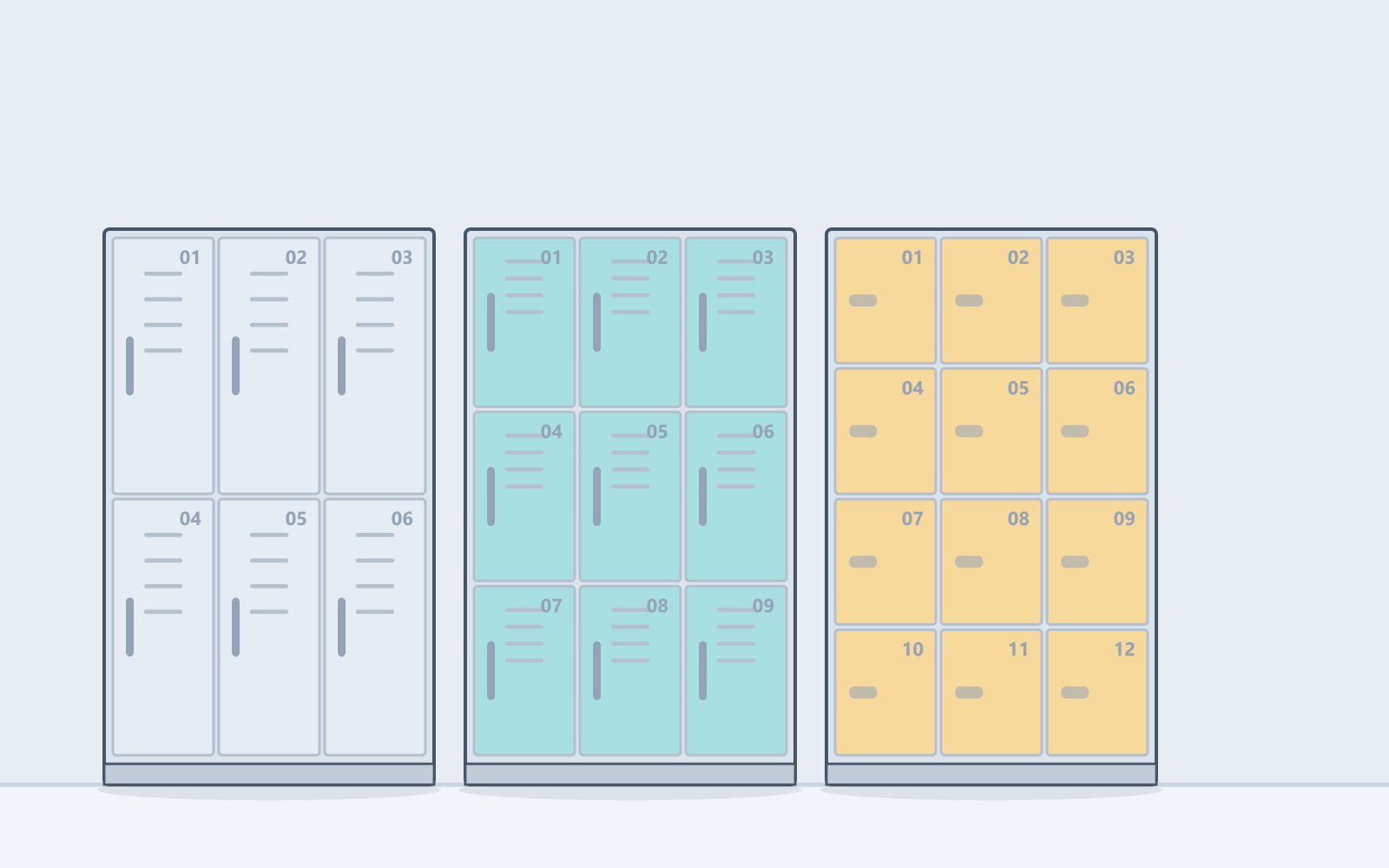
Conventional full-height changing lockers in 2 to 24 compartments, built for wet areas and daily churn. Cam locks and padlock hasps at the lowest cost per compartment, battery keypad locks where the real problem is keys going missing, or connected latches where the room has to clear itself at closing. The shells are identical, so the lock is a decision you can revisit without replacing a cabinet.
Quick answer: changing room & staff lockers in Singapore
Conventional full-height changing lockers in 2 to 24 compartments, built for wet areas and daily churn. Cam locks and padlock hasps at the lowest cost per compartment, battery keypad locks where the real problem is keys going missing, or connected latches where the room has to clear itself at closing. The shells are identical, so the lock is a decision you can revisit without replacing a cabinet.
A changing room is where the digital tier most often wins outright. A user-set keypad code needs no key at the desk, no deposit and no subscription, and it solves the single biggest complaint in a wet-area room. Move up to connected when day lockers are being squatted and you need them to release themselves. Colour finishes are made to order in any quantity that justifies a powder-coat run — blues, greens, ambers, pinks and greys are all standard pigments. Wood-effect heat-transfer finishes are available where the room is front-of-house rather than back-of-house.
Lock options
The lock is specified per bank, separately from the cabinet. We would specify digital keypad & card locks on this family unless you tell us otherwise.
| Tier | What it means here | Needs | Cost |
|---|---|---|---|
| Keyed | Cam lock, padlock hasp or combination dial. No power, no batteries, no fee. | Nothing. No socket, no battery, no connection. | Lowest per compartment |
| Digital Our default here | Battery keypad, card or fingerprint lock per door. Offline, no wiring, no subscription. | Batteries in each lock, typically replaced yearly. No socket, no cabling, no network, no IT involvement. | Mid — hardware only, no recurring fee |
| Connected | Electronic latch on the Latchwork platform — QR, PIN, card and remote release, with a full log. | One standard 3-pin 230 V socket per bank. The controller reaches us over 4G, so no structured cabling, no switch ports, no firewall rules and nothing for site IT to approve. Wi-Fi is supported where preferred. | Highest — hardware per compartment plus an annual subscription per bank |
What we would recommend, and why
A changing room is where the digital tier most often wins outright. A user-set keypad code needs no key at the desk, no deposit and no subscription, and it solves the single biggest complaint in a wet-area room. Move up to connected when day lockers are being squatted and you need them to release themselves.
Compare all three tiers →Standard configurations
These cover the large majority of enquiries and are the fastest and cheapest route to a delivered installation. Anything here can also be made to a different size.
| Configuration | Compartments | W × D × H (mm) | Notes |
|---|---|---|---|
| 2-door | 2 full-height | 850–900 × 420–450 × 1800–1850 | |
| 3-door | 3 full-height | 900 × 420–450 × 1800–1850 | |
| 4-door | 2 wide × 2 high | 900 × 420–500 × 1850 | |
| 6-door | 3 wide × 2 high | 900 × 420 × 1800 | |
| 8-door | 2 wide × 4 high | 850–900 × 390 × 1800 | |
| 9-door | 3 wide × 3 high | 900 × 400–420 × 1850 | |
| 10-door | 2 wide × 5 high | 850 × 390 × 1800 | |
| 12-door | 3 wide × 4 high | 900 × 350–390 × 1800 | |
| 15-door | 3 wide × 5 high | 900 × 350–390 × 1800 | |
| 18-door | 3 wide × 6 high | 900 × 350–390 × 1800 | |
| 24-door | 4 wide × 6 high | 900 × 350–390 × 1800 | |
| Knock-down single column | 4 or 6 high | 450 × 400 × 1850 | Ships flat and bolts together on site — for lifts and stairwells that will not take a welded bank |
Dimensions are stated as width × depth × height in millimetres throughout this site. Factory drawings often mix conventions, so confirm against the dimensioned drawing issued with your quotation before any builder’s work is committed.
Made to order
Colour finishes are made to order in any quantity that justifies a powder-coat run — blues, greens, ambers, pinks and greys are all standard pigments. Wood-effect heat-transfer finishes are available where the room is front-of-house rather than back-of-house.
Construction & specification
- Cold-rolled steel, 0.5–1.2 mm depending on panel and family, with welded or knock-down assembly
- Electrostatic powder coat, phosphate-free — standard greys and off-whites, plus colour and wood-effect finishes to order
- Louvred ventilation as standard; perforated doors or mesh backs where airflow matters more than privacy
- Cam lock, padlock hasp, coin-return lock, battery keypad lock or connected electronic latch — specified per bank
- Sloping tops to stop items being left on top of the bank, where housekeeping asks for it
- Welded plinth or 100 mm legs so floors can be hosed and squeegeed underneath
- Knock-down construction available for sites where a welded bank cannot be carried in
What goes in them
- Staff uniforms, shoes and personal effects
- Members' clothes during a swim or a class
- Wet swimwear and towels
- Contractor and housekeeping kit
- Kitchen and F&B staff belongings
- PPE and site boots
Available on our smart platform
Electronic latch on the Latchwork platform — QR, PIN, card and remote release, with a full log.
How the platform works →Who specifies these
The cabinet barely changes between these. What changes is the compartment mix, the access rules and who administers it — so it is worth reading the page written for your situation.
Changing lockers — questions we get asked
Can existing lockers be upgraded to keyless access instead of being replaced?
Usually, yes — and it is far cheaper than replacement, at either tier. The same cam lock cut-out that takes a battery keypad lock will also take a connected electronic latch with a controller at the end of the bank, so you can stop at the tier that solves your problem. We survey a sample door first, because latch geometry and door thickness decide whether the kit fits. Where a bank is too old, too thin-gauge or too corroded to hold a latch reliably, we will say so rather than sell a kit that will fail.
Should a changing room have keypad locks or connected ones?
Keypad locks if the problem is keys — lost, uncollected, cut every week — and nothing more. They are cheaper, need no socket and carry no subscription, and a member setting their own code for one session is genuinely the neatest answer to a day-use room. Move up to connected when compartments are being held overnight and you need automatic release at closing, when you want to charge for assigned lockers, or when you need to know who opened a compartment. Those three things are what a standalone lock cannot do at any price.
Which locker size suits a changing room?
For members changing for a class or a swim, 12 to 24 compartments per bank gives the most storage per metre of wall and suits day use where nothing stays overnight. For anything hung — uniforms, suits, golf bags — you need full-height 2, 3 or 4-door banks. A common answer in one room is a mix: full-height along one wall for members who store kit permanently, and high-density banks near the entrance for day use.
Will steel lockers rust in a Singapore wet area?
Powder-coated cold-rolled steel handles a changing room well, but standing water at the base is what eventually kills a locker. Specify a welded plinth or legs so the floor can be cleaned underneath, keep ventilation louvred rather than sealed, and avoid siting a bank where it takes direct spray from a shower head. For genuinely wet zones — poolside, dive rinse areas, marina pontoons — stainless steel or ABS is the right material and we will quote that instead.