- Keyed
- Digital
- Connected (our default specification)
Member Lockers
Assigned storage, with the lock the room actually needs
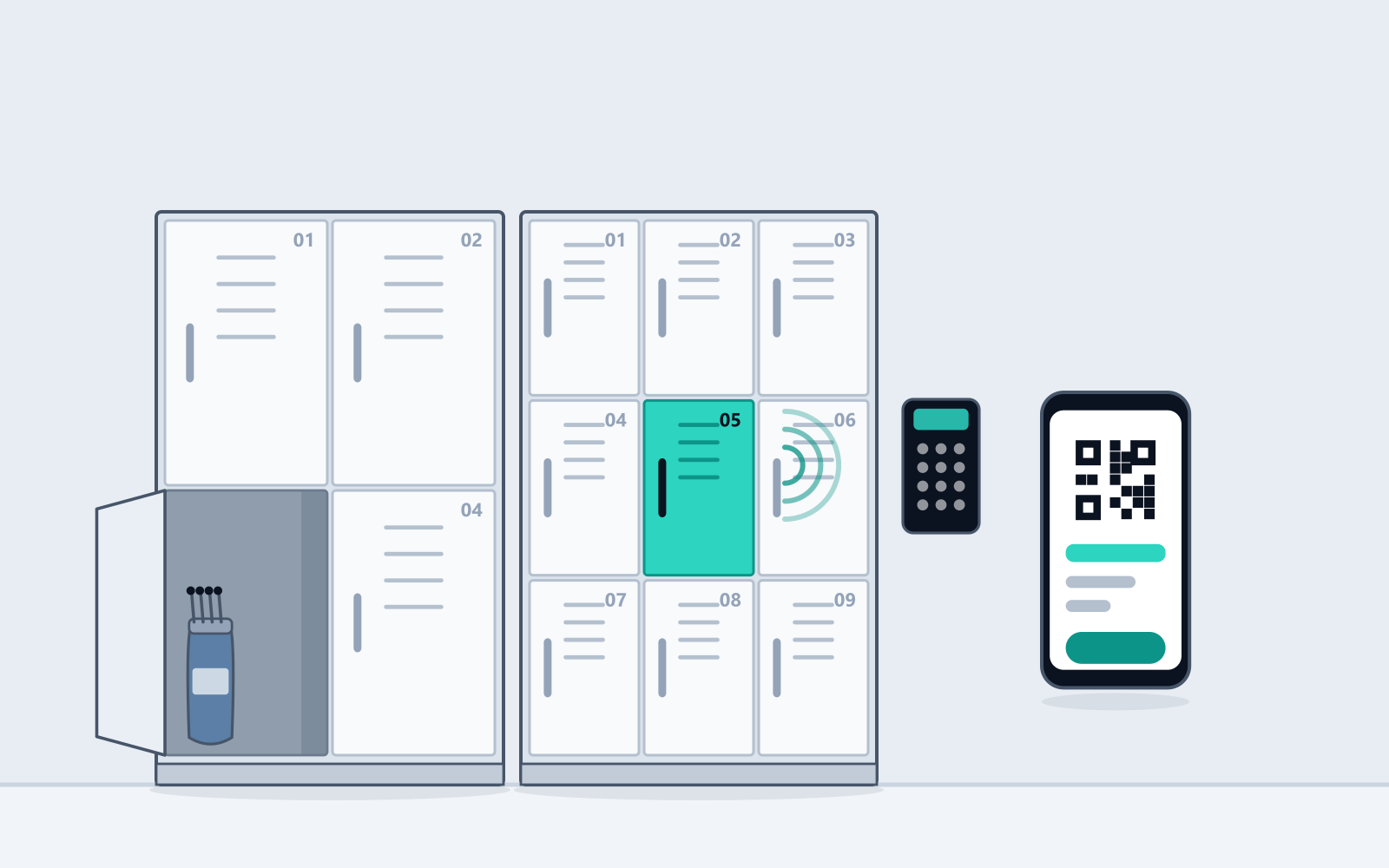
Full-height steel lockers in 2 to 24 compartments per bank, assigned to named members. Order them with keyed cam locks at the lowest cost per compartment, with battery keypad locks so nothing has to be cut or carried, or — the reason most clubs come to us — on the Latchwork platform, where members open with a QR scan or PIN, fees collect themselves and access ends the day a membership lapses.
Quick answer: member lockers in Singapore
Full-height steel lockers in 2 to 24 compartments per bank, assigned to named members. Order them with keyed cam locks at the lowest cost per compartment, with battery keypad locks so nothing has to be cut or carried, or — the reason most clubs come to us — on the Latchwork platform, where members open with a QR scan or PIN, fees collect themselves and access ends the day a membership lapses.
This is the family where connected access earns its cost most clearly: assignments change, fees are charged, and a departing member leaves a compartment that has to be recovered. We still quote keyed or keypad locks for a small, stable membership, and say so. Compartment splits, plinth height, ventilation pattern and door swing are all made to order. Banks are designed to sit flush side by side, so an odd wall length is solved by mixing widths rather than leaving a gap.
Lock options
The lock is specified per bank, separately from the cabinet. We would specify connected smart access on this family unless you tell us otherwise.
| Tier | What it means here | Needs | Cost |
|---|---|---|---|
| Keyed | Cam lock, padlock hasp or combination dial. No power, no batteries, no fee. | Nothing. No socket, no battery, no connection. | Lowest per compartment |
| Digital | Battery keypad, card or fingerprint lock per door. Offline, no wiring, no subscription. | Batteries in each lock, typically replaced yearly. No socket, no cabling, no network, no IT involvement. | Mid — hardware only, no recurring fee |
| Connected Our default here | Electronic latch on the Latchwork platform — QR, PIN, card and remote release, with a full log. | One standard 3-pin 230 V socket per bank. The controller reaches us over 4G, so no structured cabling, no switch ports, no firewall rules and nothing for site IT to approve. Wi-Fi is supported where preferred. | Highest — hardware per compartment plus an annual subscription per bank |
What we would recommend, and why
This is the family where connected access earns its cost most clearly: assignments change, fees are charged, and a departing member leaves a compartment that has to be recovered. We still quote keyed or keypad locks for a small, stable membership, and say so.
Compare all three tiers →Standard configurations
These cover the large majority of enquiries and are the fastest and cheapest route to a delivered installation. Anything here can also be made to a different size.
| Configuration | Compartments | W × D × H (mm) | Notes |
|---|---|---|---|
| 2-door | 2 full-height | 900 × 500 × 1850 | Full-length hanging space — coats, golf bags, kit bags |
| 3-door | 3 full-height | 900 × 500 × 1850 | |
| 4-door | 2 wide × 2 high | 900 × 500 × 1850 | The usual choice for racket and gym-kit storage |
| 6-door | 3 wide × 2 high | 900 × 500 × 1850 | |
| 9-door | 3 wide × 3 high | 900 × 500 × 1850 | |
| 12-door | 3 wide × 4 high | 900 × 400 × 1850 | |
| 18-door | 3 wide × 6 high | 900 × 350–390 × 1800 | |
| 24-door | 4 wide × 6 high | 900 × 350–390 × 1800 | Highest density per metre of wall — day-use and valuables |
Dimensions are stated as width × depth × height in millimetres throughout this site. Factory drawings often mix conventions, so confirm against the dimensioned drawing issued with your quotation before any builder’s work is committed.
Made to order
Compartment splits, plinth height, ventilation pattern and door swing are all made to order. Banks are designed to sit flush side by side, so an odd wall length is solved by mixing widths rather than leaving a gap.
Construction & specification
- Cold-rolled steel, 0.5–1.2 mm depending on panel and family, with welded or knock-down assembly
- Electrostatic powder coat, phosphate-free — standard greys and off-whites, plus colour and wood-effect finishes to order
- Louvred or perforated ventilation on every door — necessary for damp kit in Singapore humidity
- Cam lock, battery keypad lock or platform-connected electronic latch, specified per bank rather than per room
- Mechanical master override on every compartment whichever lock is fitted, so a flat battery or a network outage never traps a member's belongings
- Hat shelf, hanging rail and coat hooks in full-height compartments; adjustable shelf in half and quarter heights
- Recessed card holder or laser-etched numbering on each door
- Levelling feet, or a welded plinth where the floor is washed down
What goes in them
- Rackets, grips and restringing jobs
- Golf bags, shoes and trolleys
- Gym and swim kit between visits
- Squash, badminton and pickleball gear
- Wetsuits, fins and dive equipment
- Personal effects during a session
Available on our smart platform
Electronic latch on the Latchwork platform — QR, PIN, card and remote release, with a full log.
How the platform works →Who specifies these
The cabinet barely changes between these. What changes is the compartment mix, the access rules and who administers it — so it is worth reading the page written for your situation.
Member lockers — questions we get asked
Which lock should a members' locker room have?
Ask how often the assignments change and whether a fee is charged. A small club with a stable membership and no locker fee is well served by keyed cam locks, and we will quote that. Once assignments turn over, once keys start going missing, or once you are billing for lockers, the arithmetic moves: replacement cylinders, deposits and uncollected fees quietly cost more per year than better locks would. That is the point at which connected access pays for itself, and it is the most common reason a club calls us.
How does a member open a connected locker without a key or card?
Each compartment carries a QR code. The member scans it with their phone camera, the browser opens a Latchwork page that recognises which compartment it is, and if that member holds the assignment the latch releases. A numeric PIN entered on the bank's keypad works as an alternative for members who prefer not to use a phone. Nothing is installed on the phone — no app, no Bluetooth pairing, no app store download.
What happens when a member leaves or stops paying for their locker?
On the connected tier, the assignment is revoked in the dashboard and access stops immediately — there is no key to recover and no lock to re-core. Staff can trigger a remote release to clear the compartment, and the platform logs who opened it and when. Recurring fees are collected automatically by card, so a lapsed payment ends access without anyone chasing a member. With keyed or keypad locks this stays a manual job: you recover a key or reprogram a code at the door, which is perfectly workable at twenty lockers and painful at two hundred.
Can lockers be restricted to members only, or to certain member categories?
On the connected tier, yes — access rules are set per site and per bank, so a bank can be open to all verified members, limited to a category such as tennis or golf members, reserved for staff, or held for day use with an automatic release at closing. Rules can differ between banks in the same room and take effect immediately. Keyed and keypad locks cannot enforce a category; the restriction is only ever as good as who was handed the key or told the code.
Do the lockers need power and network at every bank?
Only on the connected tier, and then it is one standard 3-pin 230 V socket per bank with no fixed cabling beyond that — the controller reaches our platform over 4G, so no work is needed on the venue network and no ports need opening on your firewall. Wi-Fi is supported where you would rather use it. Consumption is a few watts standing, comparable to a phone charger left plugged in. Keyed locks need nothing at all, and battery keypad locks need a set of cells roughly once a year.