- Keyed
- Connected (our default specification)
Bespoke Equipment Lockers
Purpose-built housings for the awkward, valuable and shared
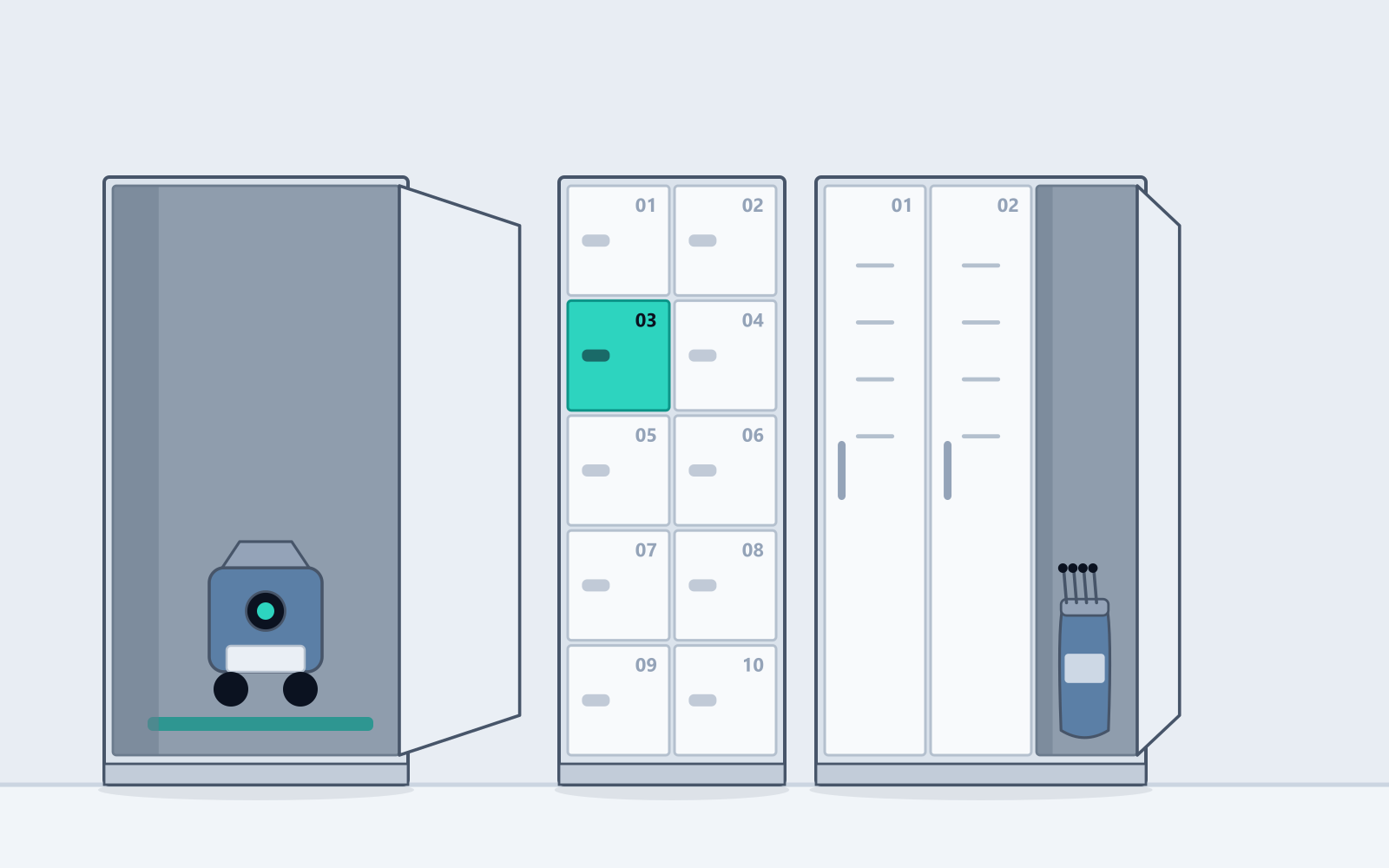
Where a catalogue compartment will not do, we build the housing around the item. This is the line Latchwork grew out of: our first cabinets were designed to hold, charge and dispense professional tennis ball machines unattended at a public sports centre, and the same approach applies to anything bulky, powered or shared between many users.
Quick answer: bespoke equipment lockers in Singapore
Where a catalogue compartment will not do, we build the housing around the item. This is the line Latchwork grew out of: our first cabinets were designed to hold, charge and dispense professional tennis ball machines unattended at a public sports centre, and the same approach applies to anything bulky, powered or shared between many users.
A bespoke housing is built around the item, and the lock follows what the item is worth and who gets it. A grounds tool store shared by a maintenance crew can run on a keyed lock. Anything valuable, powered, or issued to users without staff present is connected — that combination is what the family was designed around. A bespoke run starts from the item, not the cabinet. Send dimensions, weight, how it is moved in and out, and whether it charges — we come back with a sketch and an envelope before anything is tooled.
Lock options
The lock is specified per bank, separately from the cabinet. We would specify connected smart access on this family unless you tell us otherwise.
| Tier | What it means here | Needs | Cost |
|---|---|---|---|
| Keyed | Cam lock, padlock hasp or combination dial. No power, no batteries, no fee. | Nothing. No socket, no battery, no connection. | Lowest per compartment |
| Connected Our default here | Electronic latch on the Latchwork platform — QR, PIN, card and remote release, with a full log. | One standard 3-pin 230 V socket per bank. The controller reaches us over 4G, so no structured cabling, no switch ports, no firewall rules and nothing for site IT to approve. Wi-Fi is supported where preferred. | Highest — hardware per compartment plus an annual subscription per bank |
What we would recommend, and why
A bespoke housing is built around the item, and the lock follows what the item is worth and who gets it. A grounds tool store shared by a maintenance crew can run on a keyed lock. Anything valuable, powered, or issued to users without staff present is connected — that combination is what the family was designed around.
Compare all three tiers →Standard configurations
These cover the large majority of enquiries and are the fastest and cheapest route to a delivered installation. Anything here can also be made to a different size.
| Configuration | Compartments | W × D × H (mm) | Notes |
|---|---|---|---|
| Single-bay equipment cabinet | — | 900 × 600 × 1700–1850 | One large item plus accessory compartments — the format behind our sports equipment cabinets |
| Golf bag bank | 2–4 full-height bays | 900 × 600 × 1850 | Full-length bays with a shoe shelf below and ventilation to dry a bag out |
| Charging equipment bay | — | Made to order | Internal dock, cable management, and charge-state reporting to the platform |
| Sports kit dispensing bank | Mixed | Made to order | One large bay plus small cells for balls, grips and accessories |
| Covered-outdoor housing | — | Made to order | Sealed and drained construction for court-side, poolside and pontoon placement |
Dimensions are stated as width × depth × height in millimetres throughout this site. Factory drawings often mix conventions, so confirm against the dimensioned drawing issued with your quotation before any builder’s work is committed.
Made to order
A bespoke run starts from the item, not the cabinet. Send dimensions, weight, how it is moved in and out, and whether it charges — we come back with a sketch and an envelope before anything is tooled.
Construction & specification
- Steel body engineered around the item, with reinforcement where the load is carried
- Internal docking, cable routing and charge monitoring for powered equipment
- Ventilation and drainage designed for damp equipment rather than clothing
- Gas struts, castors, ramps or roll-out trays where the item is heavy or awkward to lift
- Sealed door edges, rain hood and a drained base for covered-outdoor placement
- Connected electronic latch and controller on the Latchwork platform, with mechanical override — or a heavy-duty keyed lock where the bay is staff-only
What goes in them
- Ball machines and training equipment
- Golf bags, trolleys and push carts
- Dive tanks, wetsuits and fins
- E-bike, scooter and tool batteries on charge
- Strollers, prams and mobility aids
- Shared maintenance and grounds tools
Available on our smart platform
Electronic latch on the Latchwork platform — QR, PIN, card and remote release, with a full log.
How the platform works →Who specifies these
The cabinet barely changes between these. What changes is the compartment mix, the access rules and who administers it — so it is worth reading the page written for your situation.
Equipment lockers — questions we get asked
What is the minimum order for a bespoke equipment locker?
A single unit, if the design is close to something we already build — our sports equipment cabinets started as one-offs. A genuinely new design carries tooling and prototype cost that only makes sense spread over a handful of units, so we will tell you honestly whether your requirement is a variation of an existing shell or a new build, and what that difference means for price and lead time.
Can a locker charge the equipment inside it and report the charge state?
Yes — this is the pattern our tennis equipment cabinets already run. The item sits on a dock inside the bay, charging begins when the door closes, and the platform reports charge state alongside occupancy. A unit can be held back from the next user until it has actually reached a usable charge, which is the difference between a shared equipment scheme that works unattended and one that generates complaints.
Will a bespoke cabinet survive outdoors in Singapore?
Under cover, yes, with the right specification — sealed door edges, a rain hood, a drained base and stainless fasteners. In fully exposed positions with driving rain and standing water, expect a shorter service life whatever the specification, and budget for it. We will always ask to see the intended position before quoting, because siting decides more about longevity here than the material does.