The range
Eight families, from smart member lockers to plain store-room shelving. Real dimensions on every standard size, badges showing which lock tiers each can be ordered at, and honest notes about where each one is the wrong choice.
Quick answer: what Latchwork supplies
Latchwork supplies eight families of steel storage in Singapore: assigned member lockers, conventional changing room and staff lockers, smart parcel and deposit lockers, device and phone charging cabinets with a socket in every compartment, bespoke equipment lockers built around a specific item, general storage cupboards and filing cabinets, secure and document cabinets along with anti-magnetic media safes, and shelving from boltless light-duty through to heavy racking and mobile compact shelving. Every family except parcel lockers can be ordered with more than one type of lock — keyed cam locks and padlock hasps, standalone battery keypad or card locks, or connected smart access on the Latchwork platform — and the lock is specified per bank rather than per room. All dimensions on this site are stated as width × depth × height in millimetres. Standard sizes cover most requirements and every family can be made to order.
- Keyed
- Digital
- Connected (our default specification)
Member Lockers
Assigned storage, with the lock the room actually needs
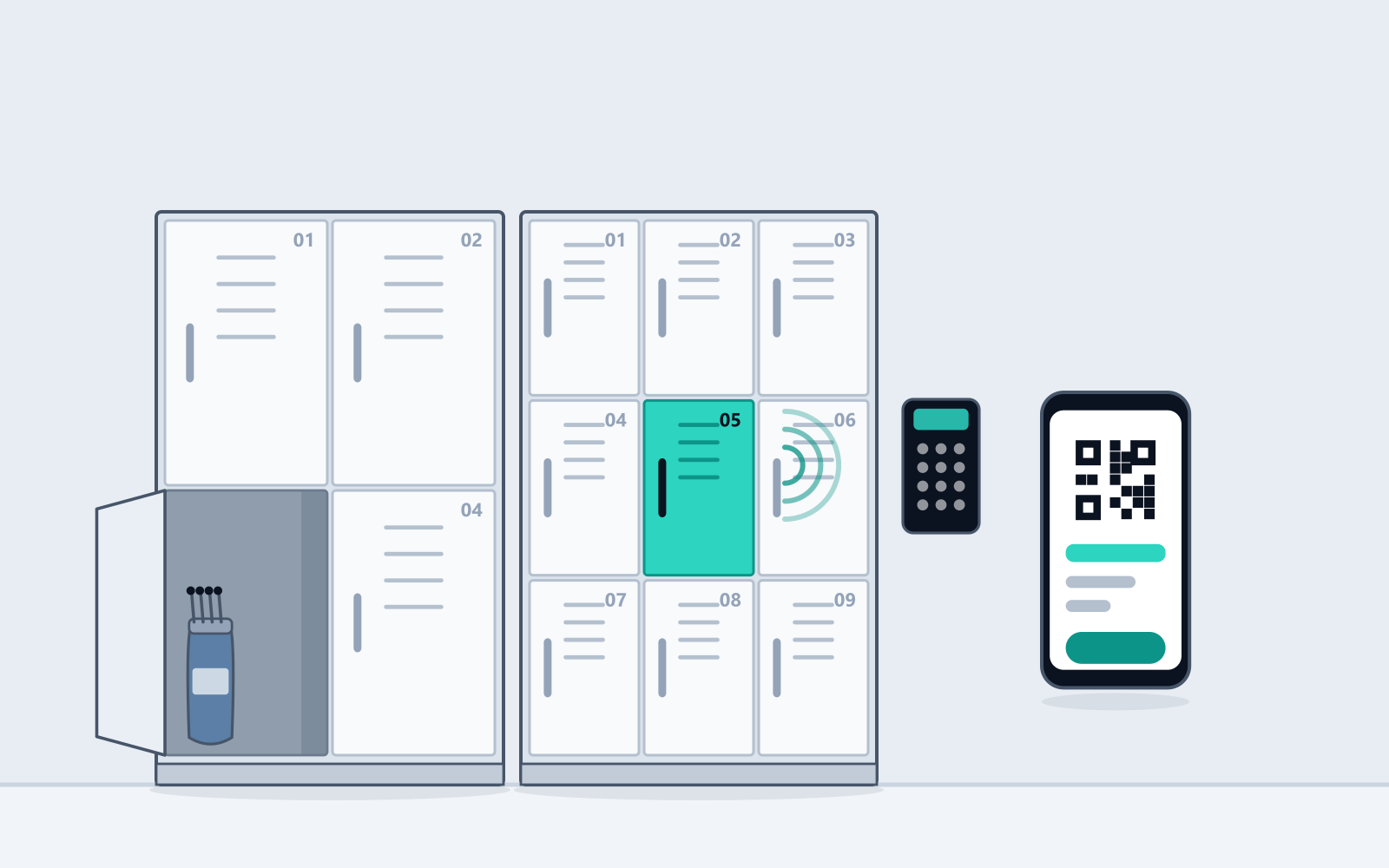
Full-height steel lockers in 2 to 24 compartments per bank, assigned to named members. Order them with keyed cam locks at the lowest cost per compartment, with battery keypad locks so nothing has to be cut or carried, or — the reason most clubs come to us — on the Latchwork platform, where members open with a QR scan or PIN, fees collect themselves and access ends the day a membership lapses.
Sizes & specification →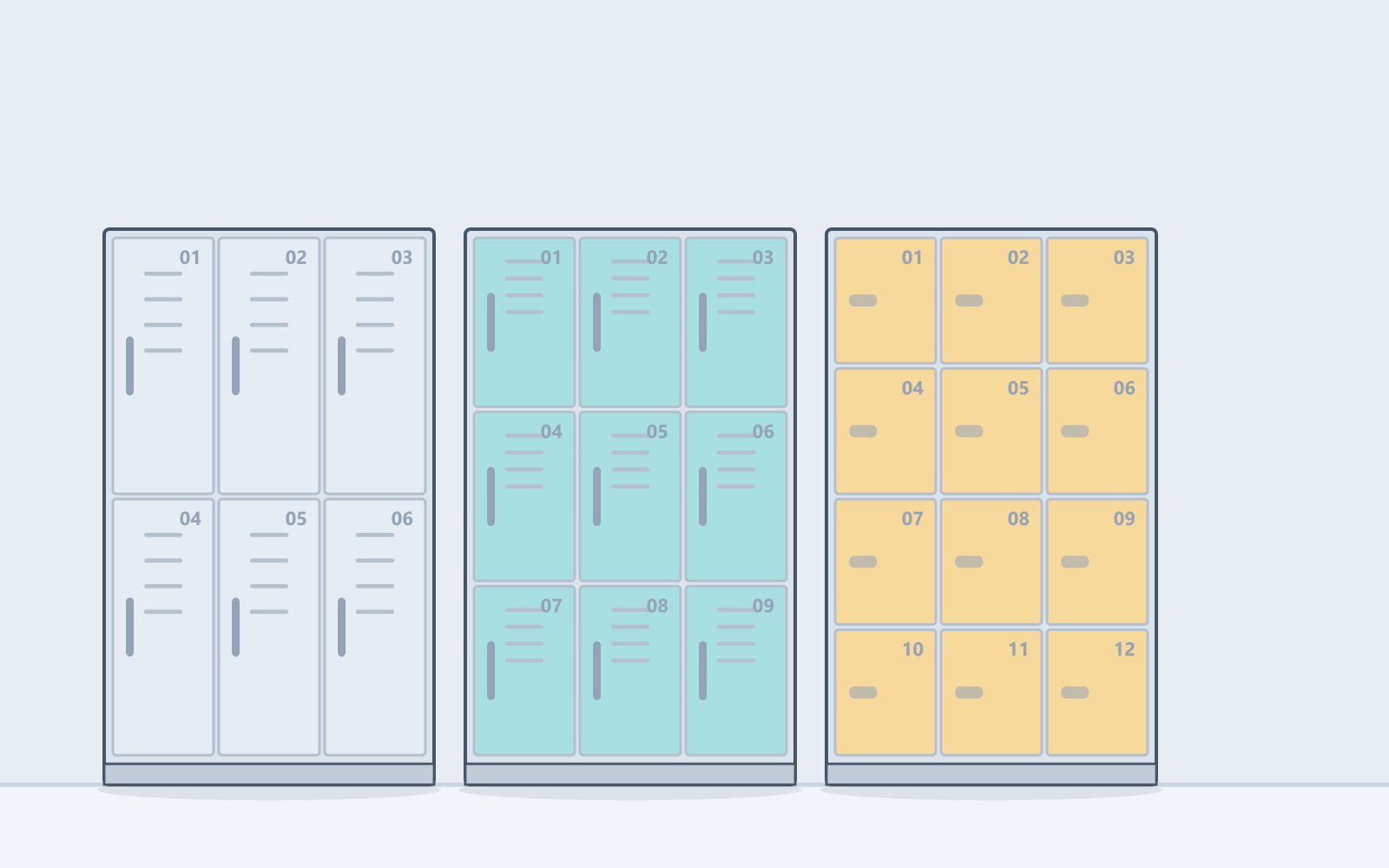
- Keyed
- Digital (our default specification)
- Connected
Changing Room & Staff Lockers
The proven steel locker, at whichever lock tier suits
Conventional full-height changing lockers in 2 to 24 compartments, built for wet areas and daily churn. Cam locks and padlock hasps at the lowest cost per compartment, battery keypad locks where the real problem is keys going missing, or connected latches where the room has to clear itself at closing. The shells are identical, so the lock is a decision you can revisit without replacing a cabinet.
Sizes & specification →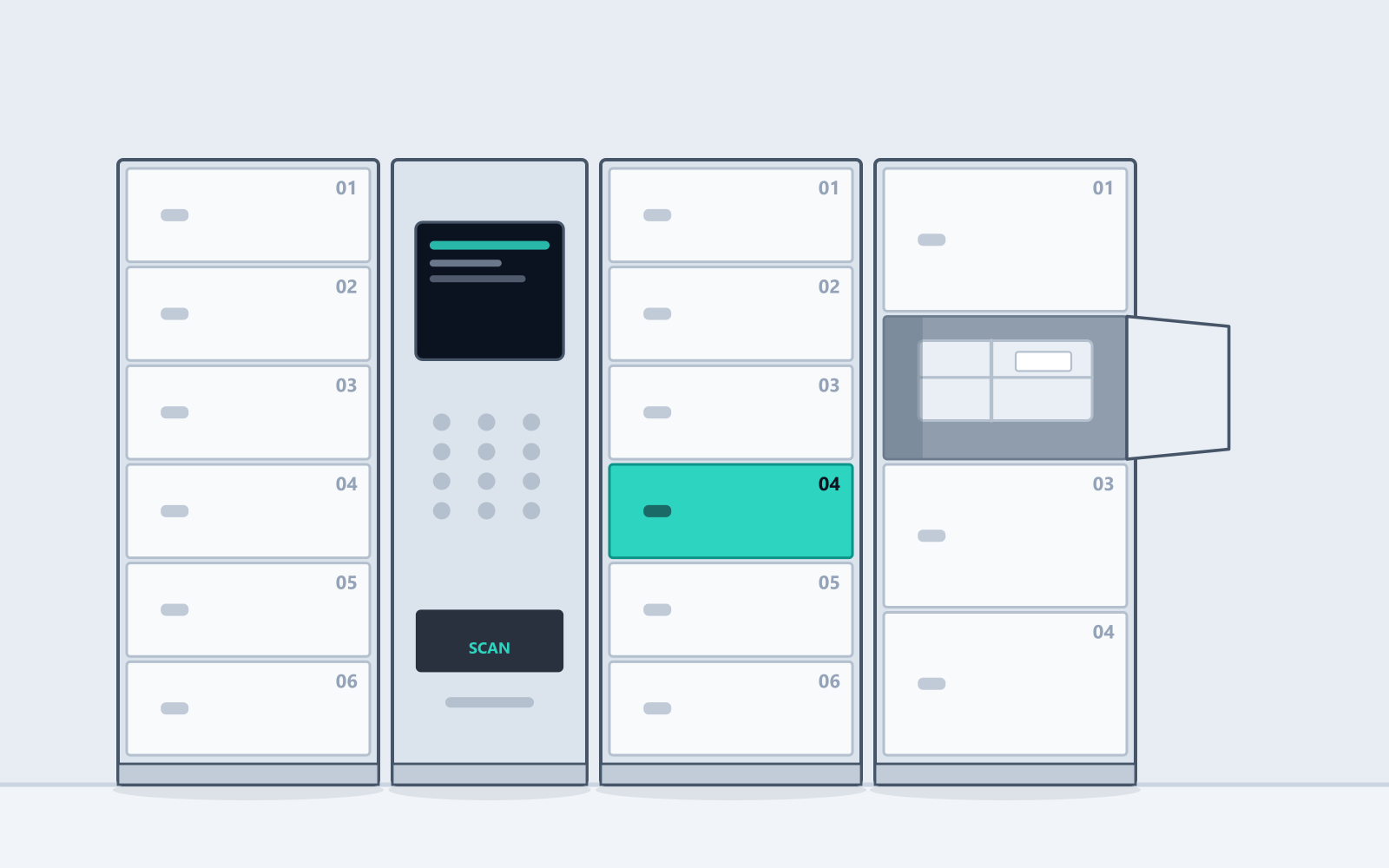
- Connected (our default specification)
Parcel & Deposit Lockers
Unattended handover, logged end to end
Multi-compartment banks with a controller, screen and keypad built in, for anything that has to change hands without two people being present. Deliveries, dry cleaning, equipment returns, key handovers and day bags all work the same way: one party drops and locks, the other gets a code, and the platform records both ends.
Sizes & specification →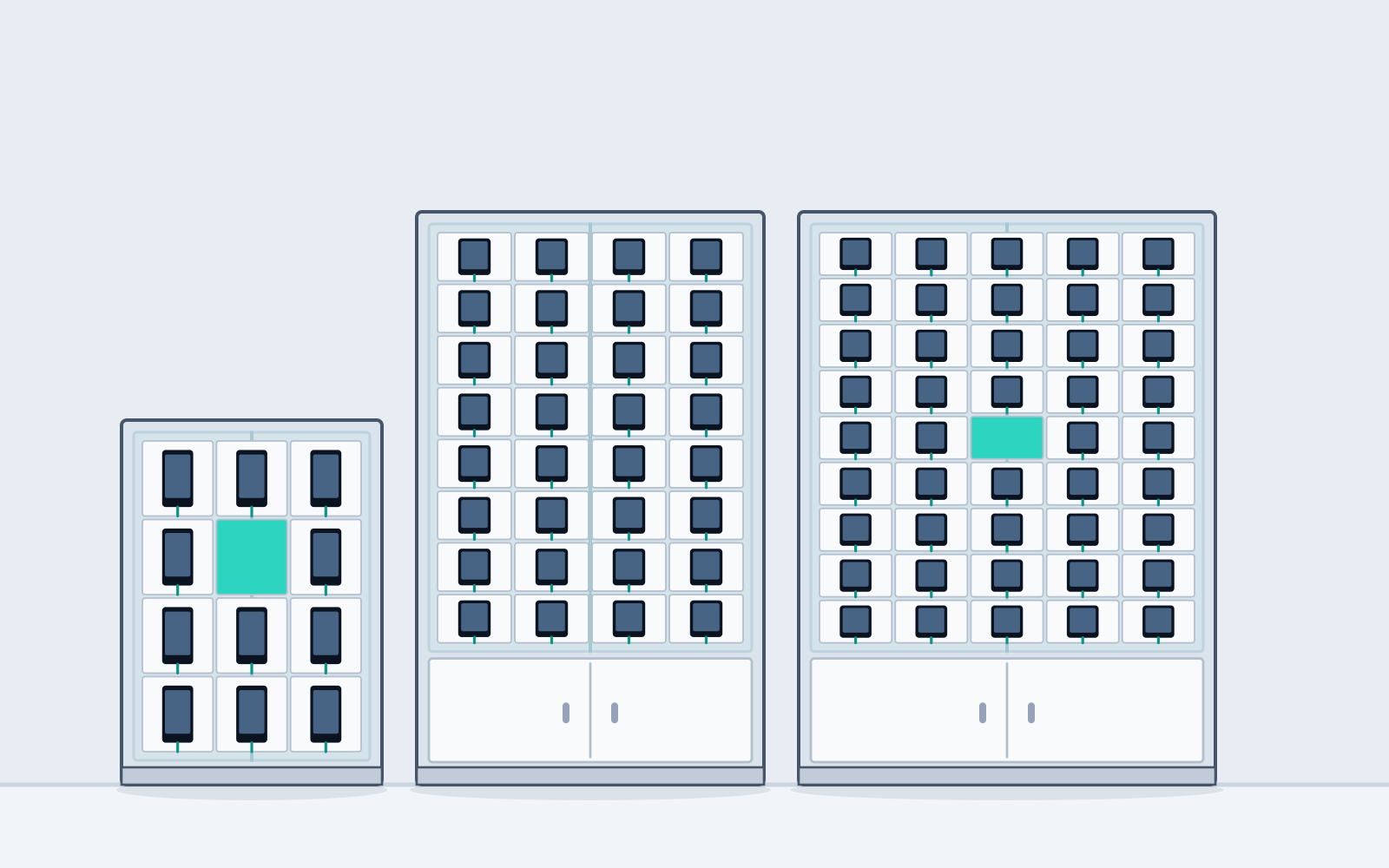
- Keyed
- Digital (our default specification)
- Connected
Device & Charging Lockers
Phones and devices stored, charged and accounted for
High-density compartment cabinets with a mains socket inside every cell, so a device charges while it is locked away. Used where phones must be surrendered — examination halls, secure meeting rooms, clean rooms, production floors — and for pooled tablets, radios and scanners that have to come back charged.
Sizes & specification →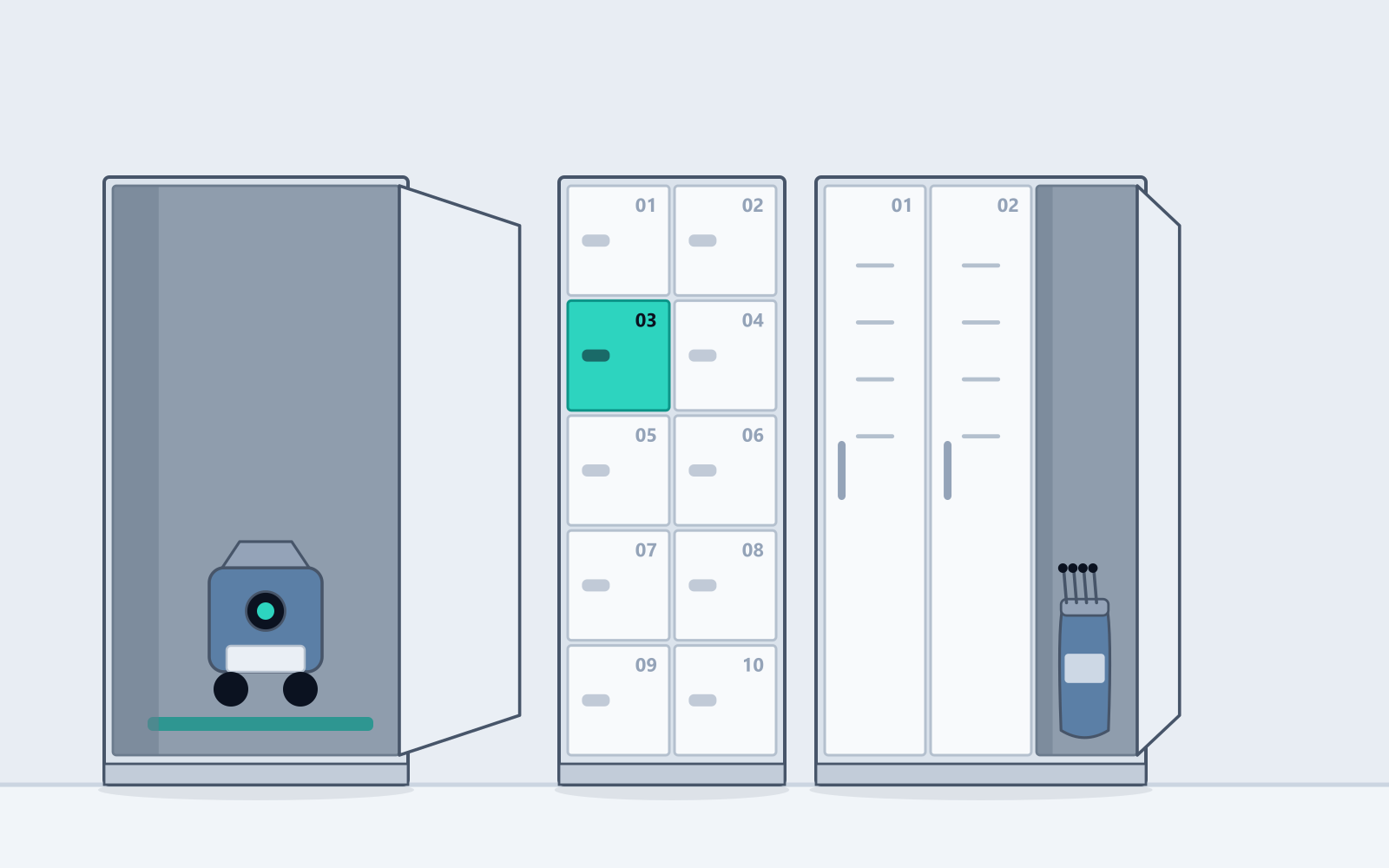
- Keyed
- Connected (our default specification)
Bespoke Equipment Lockers
Purpose-built housings for the awkward, valuable and shared
Where a catalogue compartment will not do, we build the housing around the item. This is the line Latchwork grew out of: our first cabinets were designed to hold, charge and dispense professional tennis ball machines unattended at a public sports centre, and the same approach applies to anything bulky, powered or shared between many users.
Sizes & specification →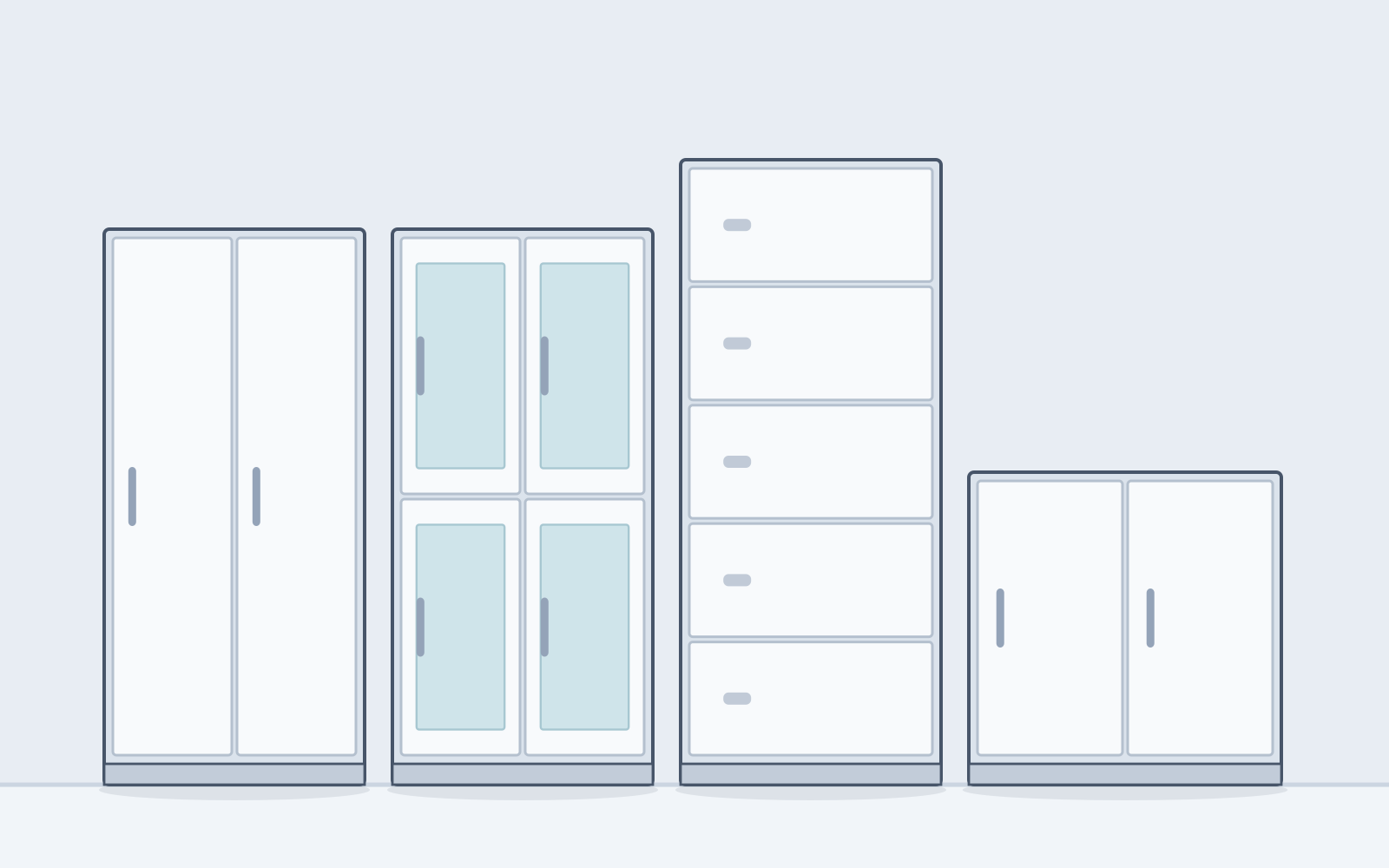
- Keyed (our default specification)
- Digital
Storage Cabinets & Cupboards
The general-purpose steel cupboard, done properly
Two-door cupboards, filing and archive cabinets, glass-fronted display units and low credenzas — the everyday storage that fills back offices, committee rooms, stores and clinic corridors. Keyed as standard and unglamorous, but the part of a fit-out that gets used every day and is noticed when it is flimsy.
Sizes & specification →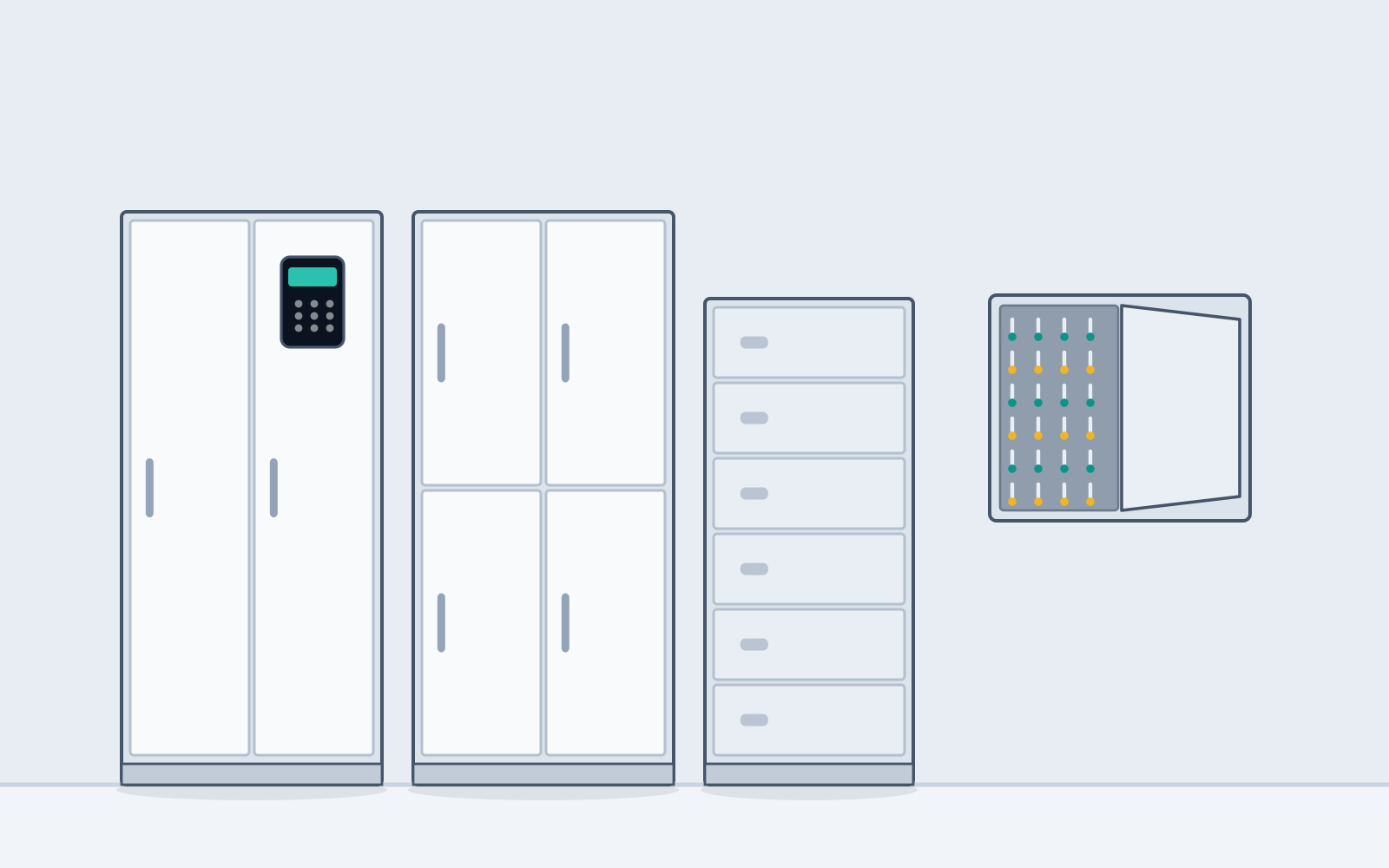
- Keyed
- Digital (our default specification)
- Connected
Secure & Document Cabinets
For records, valuables and media that must not walk
Heavier-gauge cabinets with standalone electronic combination, fingerprint or card locks, plus anti-magnetic media safes for backup tapes and drives. Specified where the requirement is not simply "lockable" but demonstrably controlled — personal data under the PDPA, cash and valuables, controlled stock, or master keys. Where "demonstrably" has to mean a written record, the same cabinet goes on the platform.
Sizes & specification →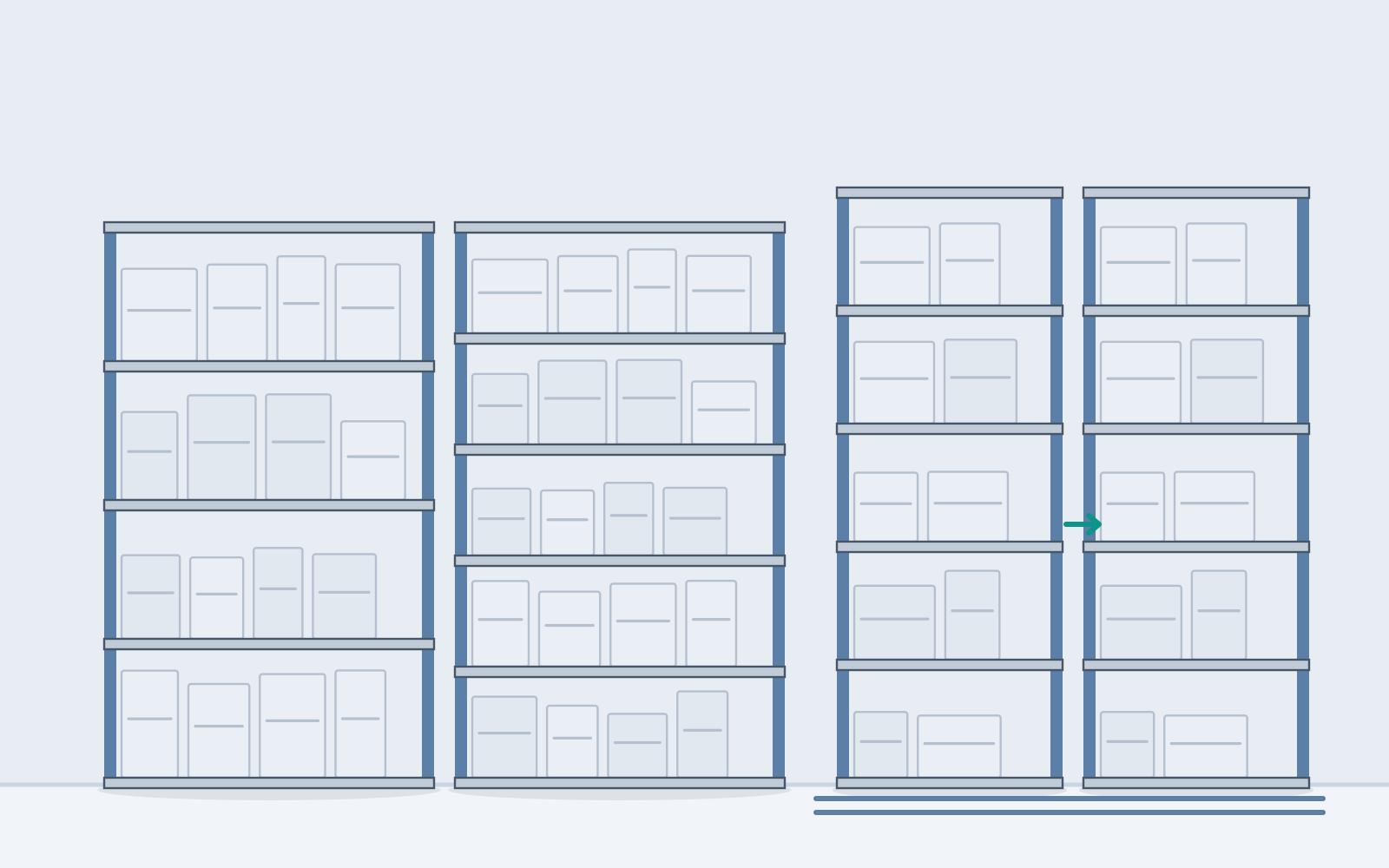
- Keyed (our default specification)
Shelving & Bulk Storage
Store rooms that hold more and stay tidy
Boltless light-duty shelving through to heavy pallet racking, plus mobile compact shelving that runs on floor tracks to recover the aisles. This is the least glamorous part of the range and often the highest-value: most store rooms we survey are holding half of what the same floor area could take.
Sizes & specification →Not everything should be smart
Connected access earns its cost where many people share a cabinet, where you need to know who opened it, or where money changes hands. On a store cupboard used by three staff, a good keyed lock is the better buy and we will tell you so. Here is which families can be ordered at which tier.
Keyed & mechanical locks
The cheapest lock that works, and it works forever. lowest per compartment.
- Member lockers
- Changing lockers
- Charging lockers
- Equipment lockers
- Storage cabinets our default
- Secure cabinets
- Shelving our default
Digital keypad & card locks
No keys, no wiring, no subscription. mid — hardware only, no recurring fee.
- Member lockers
- Changing lockers our default
- Charging lockers our default
- Storage cabinets
- Secure cabinets our default
Connected smart access
The locker room administers itself. highest — hardware per compartment plus an annual subscription per bank.
- Member lockers our default
- Changing lockers
- Parcel lockers our default
- Charging lockers
- Equipment lockers our default
- Secure cabinets
Families appear under every tier they can be ordered at. How to tell which tier your site needs →
What we need to quote accurately
The wall, not the room
Length of the run available, ceiling height, and anything in the way — a downpipe, a fire hosereel, a sprinkler head, a light switch. These decide the bank widths far more than the room area does.
The largest thing that must fit
A golf bag, a helmet, a 15-inch laptop, a rugged phone case. Compartment size follows the biggest item, and getting this wrong is the single most common cause of a locker room that nobody likes.
How many people, and how often
Permanent assignments need one compartment per person. Day use is shared across the week, so the count follows peak simultaneous attendance — often far fewer compartments than headcount.
How we get it in
Lift dimensions, door widths, stair turns, loading bay access and any hours restriction. A welded bank that will not fit in the lift becomes a knock-down bank — cheaper to know now than on delivery day.
A photo of the wall with a tape measure in shot answers most of this. Send that and we can usually give an indicative figure before anyone visits.
Range FAQ
Which locker family do I actually need?
It comes down to two questions. First, does anything get hung up? Coats, uniforms, golf bags and suits need full-height compartments, which means 2, 3 or 4-door banks. Kit dropped in for an hour does not, so 12 to 24-compartment banks give far more storage per metre of wall. Second, does the same person keep the same compartment? If yes you want assigned member lockers with billing; if no you want day-use lockers with an automatic release at closing. Get those two right and the rest is finish, lock tier and budget.
Do I have to choose the lock at the same time as the cabinet?
No, and it is worth separating the two decisions deliberately. The cabinet is the expensive, long-lived half — compartment layout, gauge, ventilation and finish are what you live with for fifteen years. The lock is the cheap, replaceable half: a standard cam lock cut-out takes a battery keypad lock, and that takes a connected latch, so a bank can move up a tier later without the steel being touched. Tell us at the survey that you may upgrade and we will make sure the cut-outs and socket positions do not become the obstacle.
Can different banks in the same room have different locks?
Yes, and most rooms should. A club locker room typically ends up with assigned member banks on the platform, day-use banks on battery keypad locks, and staff cupboards on plain cam locks — because those three groups have genuinely different problems and paying for the top tier throughout is waste. Locks are specified per bank, so mixing costs nothing beyond the hardware difference itself.
Are dimensions height first or width first?
On this site, always width × depth × height in millimetres. This matters more than it sounds: factory drawings commonly give cabinets as height × width × depth while giving charging units as width × depth × height, and mixing the two produces orders that do not fit through the door. We have normalised everything to one convention, and your quotation carries a dimensioned drawing to check builder's work against.
Can we mix families in one room?
Yes, and it is usually the right answer. A typical club locker room ends up with full-height banks along one wall for members who store kit permanently, high-density banks near the entrance for day use, and a charging cabinet by the reception. Banks are designed to sit flush side by side, so mixed widths solve an awkward wall length instead of leaving a gap.
What finishes and colours are available?
Standard finishes are grey-white, coffee-white and ivory. Colour powder coats — blues, greens, ambers, pinks, greys — are available in any quantity that justifies a coating run, and wood-effect heat-transfer finishes suit front-of-house rooms where plain steel would look institutional. Handle colour is specified separately from the body, and a contrasting handle is the cheapest way to make a functional bank look deliberate rather than cheap.
Do you supply against an architect's or tender specification?
Yes. Send the specification and we respond to it directly with dimensioned drawings, material and finish schedules, load ratings, warranty terms and compliance documentation. Where part of a specification is unwise for the application — and locker specifications sometimes are, particularly on gauge and on wet-area siting — we will say so in the submission rather than comply quietly and let it fail in service.
What is the lead time?
Standard sizes in standard finishes typically run six to eight weeks including sea freight and installation in Singapore. Custom colours add a powder-coat run; custom sizes add fabrication. Retrofit latch kits for existing lockers are much faster at two to three weeks. We do not hold large local stock, and a supplier quoting two weeks on a full fit-out is either selling someone else's stock or air-freighting at a cost that reappears in your price.