- Keyed
- Digital (our default specification)
- Connected
Secure & Document Cabinets
For records, valuables and media that must not walk
Heavier-gauge cabinets with standalone electronic combination, fingerprint or card locks, plus anti-magnetic media safes for backup tapes and drives. Specified where the requirement is not simply "lockable" but demonstrably controlled — personal data under the PDPA, cash and valuables, controlled stock, or master keys. Where "demonstrably" has to mean a written record, the same cabinet goes on the platform.
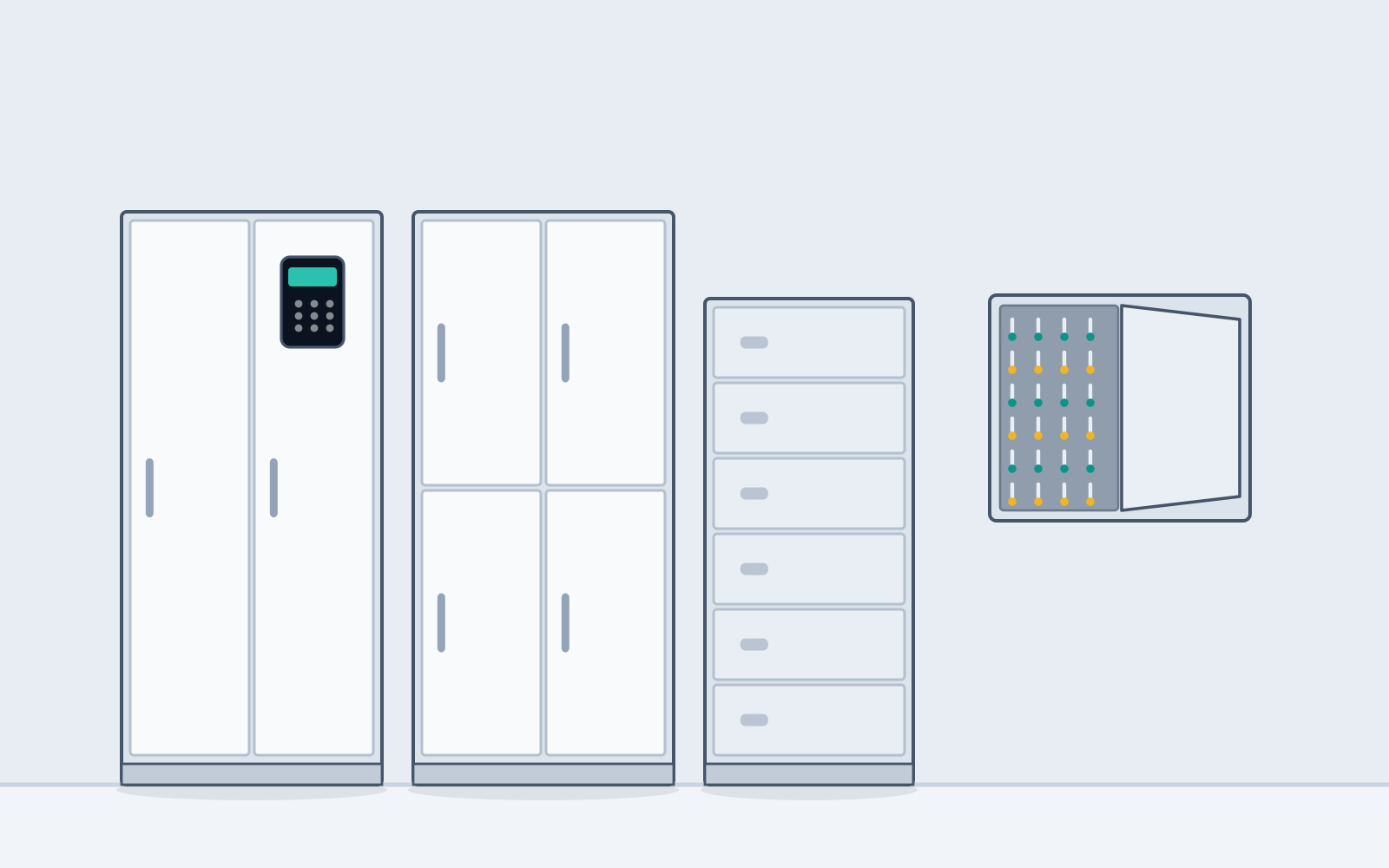
Quick answer: secure & document cabinets in Singapore
Heavier-gauge cabinets with standalone electronic combination, fingerprint or card locks, plus anti-magnetic media safes for backup tapes and drives. Specified where the requirement is not simply "lockable" but demonstrably controlled — personal data under the PDPA, cash and valuables, controlled stock, or master keys. Where "demonstrably" has to mean a written record, the same cabinet goes on the platform.
This is the family where the tier decision has consequences beyond convenience. A dual-custody two-key lock is the traditional answer and remains a good one. A standalone fingerprint or combination lock removes the shared key. Only the connected tier produces an access log, which is what turns "the cabinet was locked" into an account of who opened it and when. Lock choice matters more than steel gauge for most requirements here. Dual-custody two-key, electronic combination, fingerprint and card locks are all available standalone, and a cabinet can be brought onto the Latchwork platform where you need a record of every opening rather than just a lock. Decide that before you decide the gauge.
Lock options
The lock is specified per bank, separately from the cabinet. We would specify digital keypad & card locks on this family unless you tell us otherwise.
| Tier | What it means here | Needs | Cost |
|---|---|---|---|
| Keyed | Cam lock, padlock hasp or combination dial. No power, no batteries, no fee. | Nothing. No socket, no battery, no connection. | Lowest per compartment |
| Digital Our default here | Battery keypad, card or fingerprint lock per door. Offline, no wiring, no subscription. | Batteries in each lock, typically replaced yearly. No socket, no cabling, no network, no IT involvement. | Mid — hardware only, no recurring fee |
| Connected | Electronic latch on the Latchwork platform — QR, PIN, card and remote release, with a full log. | One standard 3-pin 230 V socket per bank. The controller reaches us over 4G, so no structured cabling, no switch ports, no firewall rules and nothing for site IT to approve. Wi-Fi is supported where preferred. | Highest — hardware per compartment plus an annual subscription per bank |
What we would recommend, and why
This is the family where the tier decision has consequences beyond convenience. A dual-custody two-key lock is the traditional answer and remains a good one. A standalone fingerprint or combination lock removes the shared key. Only the connected tier produces an access log, which is what turns "the cabinet was locked" into an account of who opened it and when.
Compare all three tiers →Standard configurations
These cover the large majority of enquiries and are the fastest and cheapest route to a delivered installation. Anything here can also be made to a different size.
| Configuration | Compartments | W × D × H (mm) | Notes |
|---|---|---|---|
| Full-height secure cabinet | — | 900 × 420 × 1850 | Electronic combination or fingerprint lock, internal drawers |
| Two-section secure cabinet | — | 900 × 420 × 1850 | Independently locked upper and lower sections for split custody |
| Under-desk secure cabinet | — | 900 × 420 × 950 | |
| Multi-compartment secure cabinet | 10 individually locked cells | 900 × 420 × 1850 | Separate custody per person or per department |
| Anti-magnetic media safe | 2 to 9 drawers, 60–180 L | 480 × 525 × 425–1500 | Internal field held below 5 Gs against 6000 Gs external |
| Key cabinet | 48–200 hooks | 380 × 60 × 400–740 | Wall-mounted, tagged and numbered |
Dimensions are stated as width × depth × height in millimetres throughout this site. Factory drawings often mix conventions, so confirm against the dimensioned drawing issued with your quotation before any builder’s work is committed.
Made to order
Lock choice matters more than steel gauge for most requirements here. Dual-custody two-key, electronic combination, fingerprint and card locks are all available standalone, and a cabinet can be brought onto the Latchwork platform where you need a record of every opening rather than just a lock. Decide that before you decide the gauge.
Construction & specification
- 1.2 mm double-skin cold-rolled steel on media safes; heavier gauge than general cabinets throughout
- Dual-custody two-key, electronic combination, fingerprint or card lock, with a mechanical override key held under separate custody
- Concealed hinges — a door with no external hinge pin cannot be lifted off
- Internal removable drawers and dividers on quality slides
- Media safes: sealed construction with fire and damp resistance, internal field below 5 Gs
- Anti-tip and floor or wall anchoring points as standard
What goes in them
- Personal data and HR records
- Member and resident records under PDPA obligations
- Cash floats, takings and petty cash
- Master keys and access devices
- Backup tapes, drives and archival media
- Controlled stock and high-value consumables
Available on our smart platform
Electronic latch on the Latchwork platform — QR, PIN, card and remote release, with a full log.
How the platform works →Who specifies these
The cabinet barely changes between these. What changes is the compartment mix, the access rules and who administers it — so it is worth reading the page written for your situation.
Secure cabinets — questions we get asked
Is a secure cabinet enough for personal data under the PDPA?
A locked cabinet is a reasonable physical security arrangement for paper records, and it is the sort of measure an organisation is expected to have in place — but it is not the whole obligation. The PDPA also expects you to control who holds access, to limit that access to people who need it, and to be able to account for it. That is precisely where a cabinet on the Latchwork platform is stronger than a cabinet with three keys in circulation: access is granted per person and every opening is logged. We are a storage supplier, not your data protection adviser, so treat this as context rather than legal advice.
What does an anti-magnetic media safe actually protect against?
Magnetic fields that would corrupt tape and legacy magnetic media, plus a degree of fire and damp protection. Ours hold the internal field below 5 Gs against an external 6000 Gs. Be clear-eyed about whether you need one: if your backups are on solid-state media or in cloud storage, a magnetic field is not your risk and a good secure cabinet with a fire rating is the more sensible purchase.
What happens if an electronic lock fails or the code is lost?
Every unit ships with a mechanical override key, which should be held under separate custody from the code — in a key cabinet, ideally, or off site. This is the single most common operational failure we see: the electronic lock works perfectly for years, then the one person who knew the code leaves, and nobody can find the override key that came in the box.